How to spot new runway construction in satellite imagery
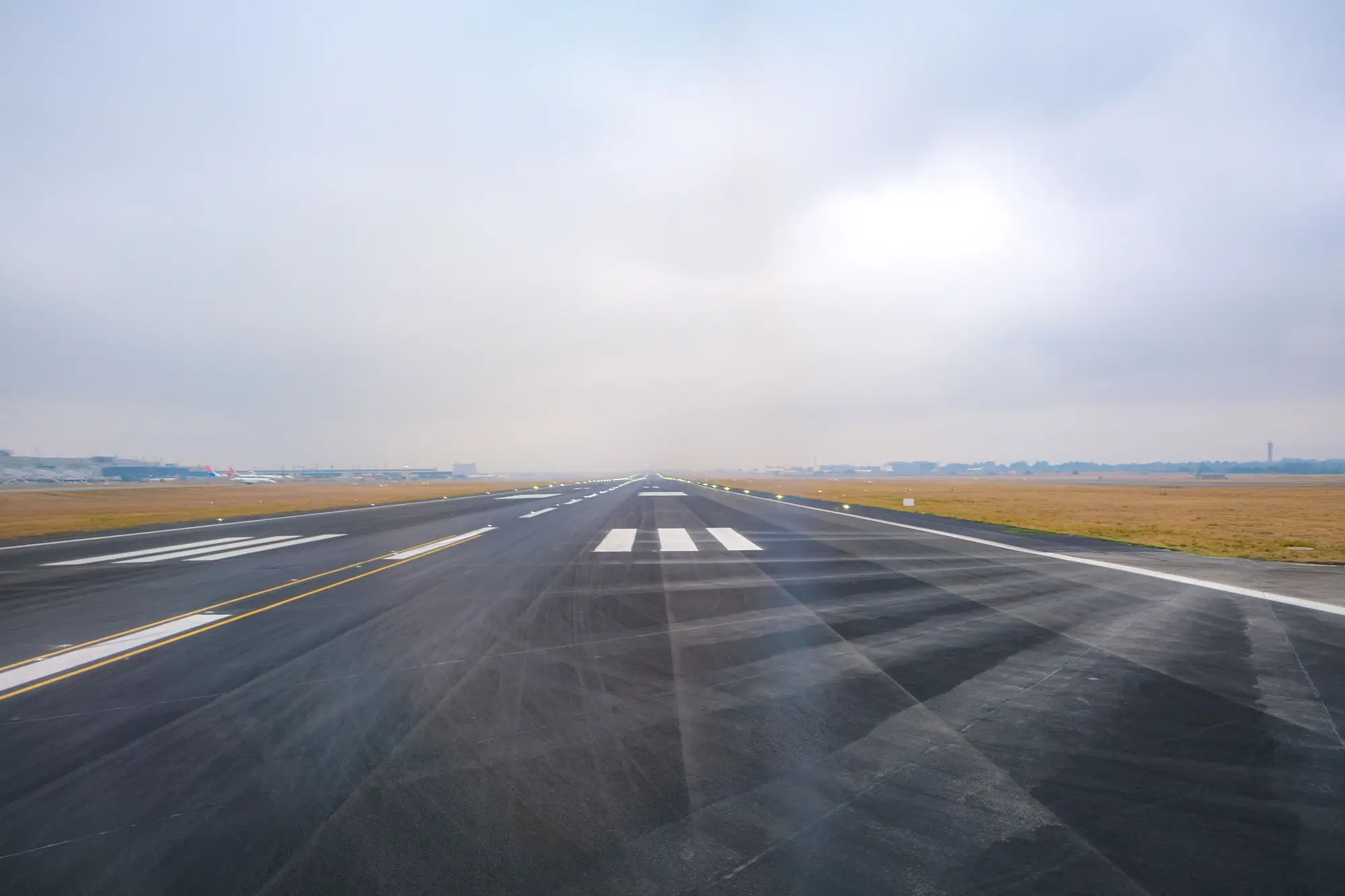
New pavement at an airbase doesn't appear overnight, and it doesn't look like finished pavement for most of the time you're watching it. If you're scanning archive tiles looking for "construction" and expecting to see a runway, you'll miss the months of groundwork that actually tell you what's being built and how big it's going to be.
Cleared earth is the first signal, not the pavement
The earliest tell is a rectangle of disturbed ground where there wasn't one before. Grading cuts show up as lighter or darker soil tone against the surrounding vegetation, often with a straight edge that doesn't match any natural feature nearby. You'll usually see haul roads branching off from an existing perimeter road before you see anything resembling a runway shape. A stockpile or two near the site, sometimes a concrete batch plant, is a decent confirming sign that this is pavement work and not a drainage project or a fence line.
At this stage the footprint matters more than anything else. Measure the cleared area's length and orientation against existing strips on the field. A new clearing running parallel to an existing runway, offset by a taxiway's width, reads differently than one running at an angle toward open ground on the field's edge.
Taxiway construction signs show up before the runway does
Taxiway work tends to lag runway clearing by a few weeks and finish faster, since there's less pavement to lay. Look for narrow linear cuts connecting the main clearing to existing apron or to a new apron pad under separate construction. A stub taxiway, a short segment that terminates in open ground with no apparent destination yet, is one of the more reliable markers that apron or shelter construction is coming next. If you see the stub but no apron activity for several passes, that's worth flagging on its own. It usually means the apron is scoped but not yet started, which tells you something about sequencing and maybe about funding or contractor availability.
Shelter and revetment construction almost always follows pavement, not the other way around. Earthwork for revetments shows up as a cluster of small mounds or a scalloped tree line near the apron edge well before any aircraft show up parked in them.
Runway extensions hide at the threshold
A runway extension is easy to miss because the existing runway looks unchanged for most of the project. The activity is at one or both ends. Watch for cleared ground beyond the existing threshold markings, especially if it's aligned with the runway centerline rather than branching off it. A displaced threshold marking, or a PAPI light array that's moved further down the strip than it used to sit, is often your first confirmation that the extension is complete and in use, sometimes before the new pavement is fully marked.
Because extensions are incremental, they're the category most likely to get lost between occasional imagery pulls. A field that goes from 2,400 meters to 3,000 meters over eight months of steady grading doesn't look dramatic in any single pair of tiles. It only reads as an extension when you're checking the same strip on a fixed cadence and comparing like for like.
Reading the whole sequence
Individually, a cleared rectangle, a stub taxiway, and a shift in PAPI position are all ambiguous. Together, in the right order, they're an airbase construction phase moving from site prep through paving to operational use. Catching this early comes down to checking the same field often enough that the sequence doesn't have gaps in it.
That's the part that's hard to do by hand across more than a handful of fields: pulling archive tiles for every site you track, every few days, and remembering what you saw last time. Airfield Activity keeps a running log of day-to-day imagery changes for a named field, so a stub taxiway or a displaced threshold shows up as a flagged change instead of something you have to notice yourself on the fortieth tile.
If you've got a field on your watch list that's been quiet for a while, it might be worth checking what Airfield Activity would have caught.